



Below is your original article, now redone with keyword-anchored links directly in the content. Each highlighted keyword or phrase is clickable and points to a reputable, live source (CDC, WHO, AAP, etc.).
If you’re a parent watching your child grow, you’ve likely wondered: Is my child developing at the right pace? Maybe your toddler just started walking later than your niece, or your preschooler still struggles with certain sounds. Questions like these can keep parents up at night—often because no one hands you a clear, realistic roadmap of what “normal” development actually looks like.
Child development milestones aren’t just about checking boxes on a chart. They’re clues—signals that help you understand how a child is learning, adapting, and building the foundation for future success in school and life. Resources like the CDC developmental milestones and WHO healthy growth and development pages show that milestones are meant to guide, not to label.
By the end, you’ll have a grounded understanding of how children grow physically, cognitively, emotionally, and socially—and practical guidance on how to support that growth at home and in school.
Understanding Child Development Milestones
Before we dive into stages, it’s worth clarifying what milestones really mean.
A developmental milestone is a skill or ability most children can do by a certain age—such as walking, talking, or problem-solving, as defined in programs like Learn the Signs. Act Early.. They’re benchmarks, not deadlines. Every child develops at their own pace, and some variations are completely normal. However, patterns matter. When a child consistently misses several milestones or loses skills they once had, that’s a signal to look deeper, which is why pediatric guidance such as the AAP early childhood resources strongly encourages ongoing developmental monitoring.
The Four Core Areas of Child Development
- Physical (Gross and Fine Motor Skills): Movement, coordination, balance, and muscle control, often grouped as physical development milestones in medical and parenting resources.
- Cognitive (Thinking and Problem-Solving): Memory, logic, curiosity, and the ability to learn, covered in many summaries of child development stages.
- Language (Communication): Understanding and using words, gestures, and tone, which show up clearly in speech and language milestones for different ages.
- Social-Emotional: Self-regulation, relationships, empathy, and adaptability, core to frameworks described in Ages & Stages from HealthyChildren.org.
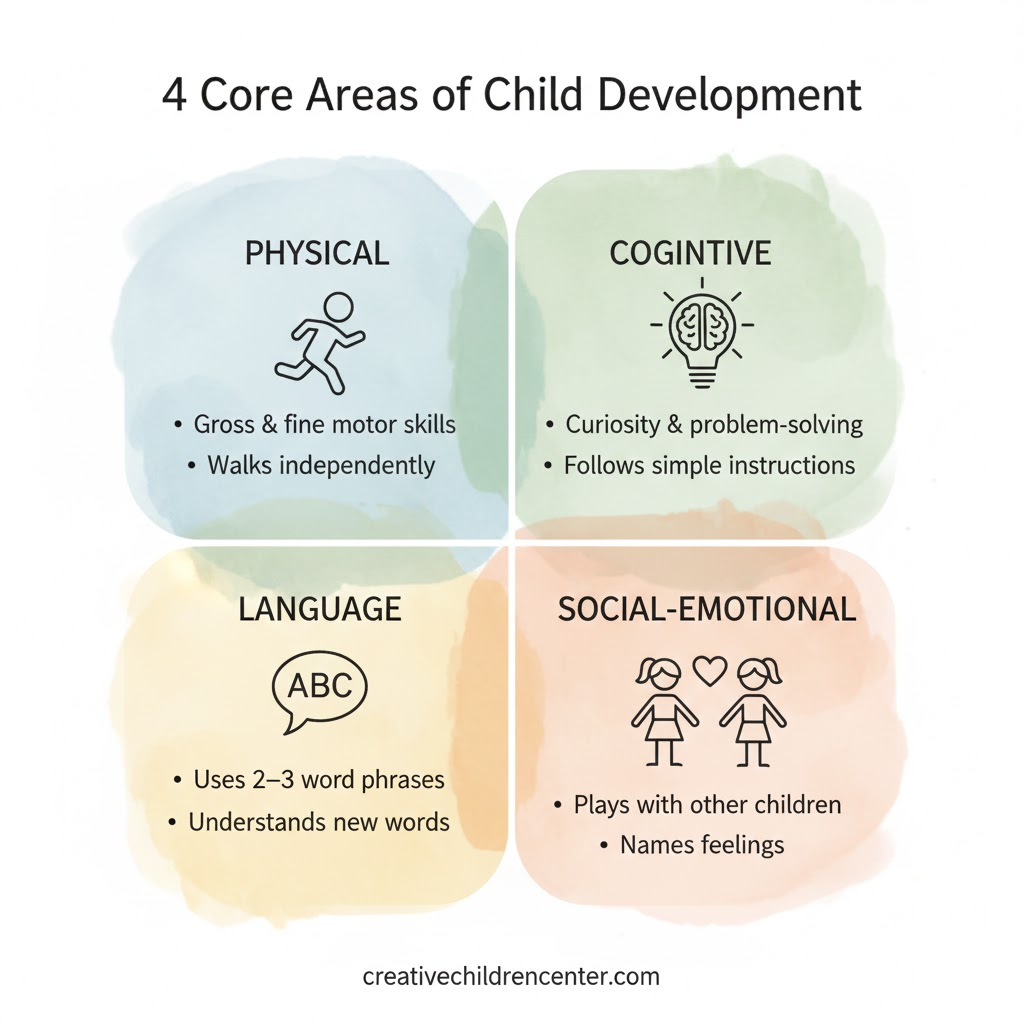
Each area interacts with the others. A child who struggles socially may lag in language because communication feels harder; a motor delay might affect play, which then affects social development. That’s why holistic observation matters more than any single checklist, a point echoed in broad overviews of child development.
Why Developmental Awareness Matters
Most parents just want their child to do well in school. But school readiness is built long before kindergarten. The ability to sit still, follow instructions, focus on a story, or manage frustration—all of it ties back to early developmental foundations described in early childhood guidance from the AAP.
In my experience, parents who understand milestones don’t panic over every small delay. Instead, they become better guides—knowing when to encourage, when to wait, and when to seek support. The goal isn’t perfection—it’s awareness.
When you understand how children typically progress, you can:
- Notice potential concerns early using tools like the CDC Milestone Tracker app.
- Encourage skills that match your child’s stage of growth, using age-based tips such as positive parenting for infants and young children.
- Communicate effectively with teachers and pediatricians, using shared language from trusted sources like Healthy People 2030 – Learn the Signs. Act Early..
- Support emotional confidence—because children sense when you “get” them.
Developmental Stages and Key Milestones
Let’s walk through the major stages of development, from infancy through early school age. Remember, these are general guidelines. A few months’ variation is normal. What matters is ongoing progress and engagement with the world, as reflected in many summaries of the 5 stages of child development.
Infancy (0–12 Months): Foundations of Growth
The first year is astonishing. Babies transform from completely dependent newborns into mini-explorers.
Physical Development
- Lifts head (by 2–3 months).
- Rolls over, sits up, then starts crawling (around 6–9 months).
- Stands with support and may take first steps closer to 12 months.
These abilities are listed in detail in infant developmental milestones and similar charts.
Cognitive and Language
- Tracks movement with eyes and recognizes familiar faces.
- Explores by grasping, shaking, mouthing objects.
- Responds to name and simple phrases (“Bye-bye!”).
- Says first words around 12 months.
This early “sensorimotor” period is described in many overviews of child development stages.
Social and Emotional
- Smiles responsively around 2 months.
- Enjoys interactive games like peekaboo.
- Shows stranger anxiety or strong attachment to caregivers.
Common mistake: Some parents worry if their baby isn’t walking by the first birthday. What matters more is overall movement and strength. Late walkers often catch up quickly once ready, and the 1-year milestones from the CDC emphasize a range of normal.
Toddlerhood (1–3 Years): The Stage of Independence
This is the “I do it myself!” phase—messy, loud, and full of discovery.
Physical
- Walks steadily, runs, climbs stairs with help.
- Begins to use utensils, stack blocks, and scribble.
- Potty learning may begin late in this phase.
These skills align with toddler developmental milestones and CDC toddler parenting tips.
Cognitive
- Sorts shapes, recognizes simple patterns.
- Follows one- to two-step instructions.
- Begins pretend play (feeding a doll, mimicking adults).
Language
- Vocabulary explodes from a few words to hundreds.
- Forms short sentences by age 2–3.
- Understands much more than they can say.
The “language explosion” around this age is a common theme in toddler ages & stages resources.
Social-Emotional
- Shows empathy (comforts another child).
- Begins parallel play (playing near, not with, others).
- Starts expressing strong preferences—sometimes very strongly.
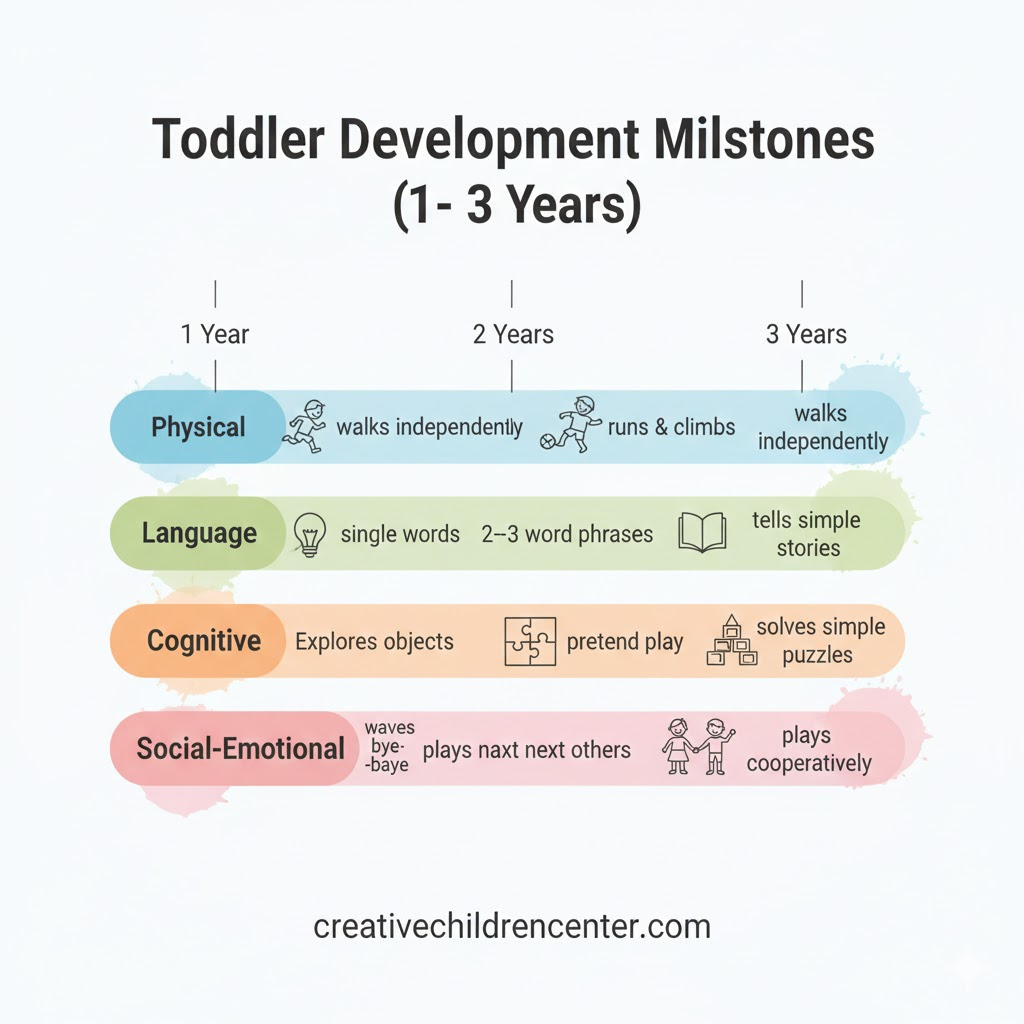
Here’s where things often go wrong: parents expect toddlers to share or behave like older children. But emotional regulation develops slower than motor skills. Tantrums aren’t failures—they’re signs of a rapidly developing brain learning limits and autonomy, a concept explained in many positive parenting guides.
Preschool (3–5 Years): The Imagination Years
Preschoolers are natural storytellers. Their play expands, their language skills explode, and they begin asking “why?”—constantly.
Physical
- Climbs, jumps, pedals a tricycle, and catches a ball.
- Draws shapes, starts writing letters, uses scissors safely (with supervision).
Cognitive
- Understands time concepts (“after lunch,” “tomorrow”).
- Solves basic puzzles and sorts objects by multiple traits.
- Begins counting, identifying colors, and learning basic letters.
These are typical of the preschool development stage and early learning checklists.
Language
- Speaks in complete sentences.
- Can be understood by strangers.
- Uses plurals, tenses, and imaginative storytelling.
Social-Emotional
- Forms real friendships and plays cooperatively.
- Begins understanding other perspectives.
- Starts to self-manage emotions (though far from perfect).
This stage sets the tone for school readiness. A child who can focus for 10–15 minutes, follow directions, and express needs calmly will adapt much better to classroom routines, as reflected in preschool readiness and ages & stages.
Early School-Age (5–8 Years): Expanding the World
The school years bring structure, challenges, and major cognitive leaps. Children start comparing themselves with peers and developing self-esteem based on performance.
Physical
- Improved agility and coordination.
- Can dress independently and manage personal hygiene.
- Shows interest in sports or movement-based group play.
Cognitive
- Reads simple words and understands stories.
- Solves problems independently using logic (“If I can’t find it here, maybe it’s there”).
- Learns to plan small tasks and persist through frustration.
You’ll see similar descriptions in general guides to child development stages.
Language and Communication
- Richer vocabulary and storytelling ability.
- Understands figurative language and humor.
- Begins written expression.
Social-Emotional
- Increasing empathy and cooperation.
- Understands fair play and rules.
- Seeks approval from peers and adults.
What most people don’t realize is that academic learning depends heavily on emotional maturity. A child’s ability to focus, cooperate, and tolerate “not being the best” is as critical as their reading level, a theme reinforced by AAP early childhood resources.
Common Myths and Misconceptions About Child Development
No parent is immune to comparison, judgment, or misinformation. Let’s address a few recurring misconceptions.
Myth 1: “Earlier is always better.”
Parents often equate early skill development with intelligence or potential. But earlier isn’t always better—it’s just earlier. For example, a child who walks at 9 months and one who walks at 15 months typically perform equally well later. The difference often lies in temperament, muscle tone, or natural variation.
Rushing development can actually backfire, causing frustration or burnout. The revised CDC milestone checklists intentionally set milestones at ages when about 75% of children can do a skill, to reduce unnecessary worry and “race to be first” thinking.
Myth 2: “If my child speaks late, there’s automatically a problem.”
Some children focus first on motor or spatial skills and speak later without issue. Others may need extra language stimulation or hearing checks. Context matters—late speech combined with poor eye contact or lack of gestures is worth assessing sooner rather than later.
The key is the total communication picture, not just vocabulary count. Changes to CDC speech and language milestones highlight that both gestures and social engagement are important clues.
Myth 3: “Good parenting means constant stimulation.”
Over-scheduling toddlers with lessons and flashcards often leads to exhaustion rather than acceleration. Children learn best through exploration, play, and meaningful interaction—not constant instruction.
In my experience, what children crave most is engaged presence, not multitasked teaching. Evidence-based parenting tips such as positive parenting strategies emphasize play, routines, and emotional connection over nonstop “enrichment.”
Myth 4: “Boys just develop slower, so it’s fine.”
While boys often trail slightly in language milestones, that gap shouldn’t excuse ignoring persistent delays. Significant lags in communication or social interaction deserve attention, regardless of gender.
Early support helps both boys and girls thrive later in structured classrooms. Relying on gender stereotypes can delay needed evaluations, which runs counter to the message of programs like Learn the Signs. Act Early..
Recognizing When to Seek Help
It’s natural to worry. But the real art lies in knowing when to act. A single missed milestone isn’t cause for panic. Patterns, however, are informative.
Red flags worth discussing with your pediatrician or teacher:
- Loss of previously acquired skills.
- Lack of eye contact or response to name.
- Limited emotional expression or engagement.
- Difficulty following simple directions by age 3.
- Persistent clumsiness or fine-motor struggles.
- Speech that’s hard to understand past age 4.
Many of these signs appear in CDC milestone red flag lists. Early intervention can make a profound difference. Many developmental challenges—speech delays, sensory sensitivities, attention issues—respond well to early support.
Parents can find additional guidance and referral information through Bright Futures family resources and pediatric sites like HealthyChildren.org.
How Parents Can Support Development at Home
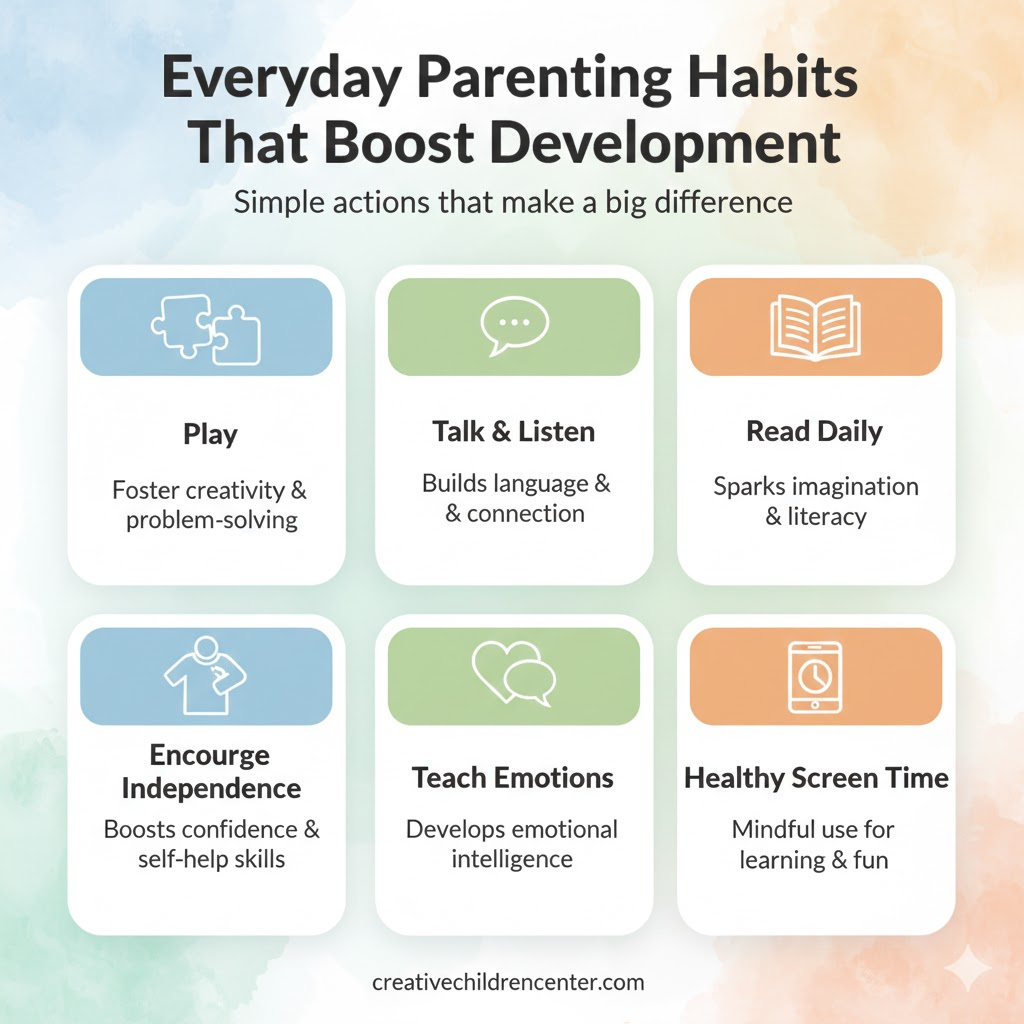
Supporting your child’s growth doesn’t require elaborate programs. It’s about small, consistent habits woven into daily life.
1. Prioritize Play
Free, unstructured play remains one of the most powerful learning tools. It builds problem-solving, creativity, and self-control.
Rotate toys occasionally to spark curiosity rather than overwhelming with quantity. Many early childhood organizations stress play-based learning as the foundation of early development.
2. Talk—and Listen—Constantly
Narrate routines (“We’re washing the apples now”), describe emotions, and pause for your child’s reply. Language growth thrives on two-way conversation, not one-way correction.
This “serve and return” style of interaction is central to infant and toddler communication tips and promotes strong neural connections.
3. Read Every Day
Books expose children to vocabulary, sequence, and empathy. Picture books are great, but so are pointing, asking questions, and relating stories to real life (“Remember when we went to the park like that?”).
Many pediatricians recommend daily shared reading, as outlined in reading with your baby and similar guidance.
4. Encourage Independence
Let children try, fail, and try again—tying shoes, pouring water, organizing school bags. Frustration tolerance is a skill, too.
Supporting age-appropriate independence is associated with healthier adjustment in the early school years, as reflected in school-age development resources.
5. Nurture Emotional Skills
Model calm self-talk, name feelings (“You look disappointed”), and teach coping tools like breathing or taking breaks. Emotional literacy supports both relationships and learning.
A relational perspective on parenting and child development highlights how emotional connection and co-regulation protect long-term mental health.
6. Balance Screen Time Wisely
Screens aren’t inherently harmful, but passive consumption displaces interaction. Co-view educational videos, discuss content, and set consistent limits.
The AAP family media guidelines recommend a family media plan and focusing on interactive, high-quality content over background or unsupervised use.
How Schools Fit Into the Picture
Teachers often observe patterns parents don’t see. Classroom settings test attention, memory, and cooperation in new ways. Good communication between school and home prevents misunderstandings.
Here’s what cooperative monitoring looks like:
- Share insights about your child’s strengths and sensitivities.
- Ask about classroom behaviors (focus, social play, communication).
- Align expectations—home support is most effective when parents know what teachers emphasize.
Resources for parents, such as Ages & Stages on HealthyChildren.org and AAP DC parents & families, encourage this partnership approach.
If your child receives developmental or learning support, maintain open dialogue. Progress monitoring and small adjustments matter more than labels.
Navigating Differences in Development
No two children develop identically. Even siblings who share the same environment can vary wildly in temperament, learning style, and motivation.
Some differences stem from:
- Genetics and birth factors.
- Cultural expectations (what’s encouraged or valued early).
- Temperament (shy vs. adventurous children explore differently).
- Opportunities for movement, language, and play.
As a parent, your job isn’t to eliminate differences—it’s to understand them. Some “slow” skills blossom later with maturity. Others need structured support. The key is staying observant and flexible, not rigidly applying timelines.
Developmental summaries like Understanding the stages of child development and broad references on child development repeatedly emphasize that “normal” covers a wide range.
Practical Tools for Tracking Progress
You don’t need complex software to keep tabs on your child’s growth. A simple monthly reflection works wonders. Note new skills, challenges, and social changes. Over time, you’ll see patterns—not just data points.
Ideas to simplify tracking:
- Use CDC milestone checklists or similar tools recommended by your pediatrician.
- Keep a small notebook or app for quick notes (“First drew a person today”).
- Capture videos occasionally—they reveal more than memory alone.
- Review with teachers or caregivers every few months.
A developmental milestones chart can be an invaluable reference, as long as you treat it as a guide, not a scorecard.
When “Good Enough” Truly Is Enough
One of the hardest truths for parents to accept is that mastery comes gradually. Children don’t develop linearly or predictably. A child who lags in one area often surges in another.
It helps to remember: education isn’t a race; it’s a rhythm. What defines success is emotional security, curiosity, and persistence—not just milestone timing.
In many cases, being a calm, responsive parent matters far more than orchestrating perfect learning environments. Children thrive when they feel seen, safe, and challenged—not hurried or compared. That message runs through many resources for families supporting children’s growth.
Common Parental Pitfalls (and How to Avoid Them)
- Comparing constantly. Every child has a different developmental fingerprint. Comparison steals joy and perspective. Articles on understanding CDC milestone updates consistently remind parents to focus on patterns, not peer comparison.
- Overreacting to single incidents. One tantrum, skipped word, or rough drawing doesn’t define progress. Look for consistent patterns instead.
- Ignoring gut instincts. If you sense something’s off—speech regression, withdrawal, apathy—trust that intuition. Raise it gently with professionals, using language from Learn the Signs. Act Early. or similar resources.
- Neglecting emotional foundation. A stressed or over-disciplined child may regress developmentally. Emotional warmth fuels growth more than perfectionist structure, as highlighted in positive parenting tips.
Conclusion: Building Confidence in Your Child’s Journey
Understanding child development milestones isn’t about memorizing lists. It’s about tuning in—seeing your child as a growing system of body, mind, and emotion, not a set of boxes to check.
Here’s what to take away:
- Milestones are guides, not judgments, as emphasized throughout CDC milestone resources.
- Progress matters more than perfect timing.
- Early awareness and genuine engagement prevent larger struggles later.
- Emotional security and curiosity power all learning.
Realistic Next Steps
- Observe and document using a simple notebook or an app like the CDC Milestone Tracker.
- Read and talk daily, following practical ideas from Ages & Stages.
- Build consistent routines combining play, rest, and independence.
- Foster trust with teachers and healthcare providers, bringing specific questions informed by Learn the Signs. Act Early..
- Celebrate small wins. Development is cumulative—and joy accelerates growth.
In the big picture, children develop best when parents trade anxiety for attentiveness. Growth is fluid, nonlinear, and beautifully personal. By understanding milestones in context and using trusted resources, you’re not just tracking your child’s development—you’re nurturing their confidence, curiosity, and lifelong love of learning.